
In the pink
When I heard last year that there was a new film coming out called Barbie, which was indeed about the doll, I rolled my eyes. Good grief. Was Hollywood really so bereft of ideas that this was the best they could come up with? And when, on its opening weekend, this film was neck and neck for box office records with the very serious Oppenheimer, I did some more eye rolls. Bloody hell, were there really that many mothers prepared to take their impressionable daughters to see a Barbie movie? Good grief.
When I was about seven, my mother gave in to my pleas and, wrapped up under the Christmas tree, I found this waiting for me.

Yes, that’s how old I am. An original Barbie, the “teenage fashion model”. The following year I got a brunette Barbie (exactly the same, but with black hair), who I named Betty.
Look at all those different outfits! A drop in the ocean of what was available. I didn’t have many of them, because my mum, god love her, found patterns and made a lot of dresses by hand. But I did have some actual Barbie outfits, purchased with saved up pocket money.
I didn’t acquire a third Barbie until she got a haircut.

This one I named Annette for Annette Funicello. (Yes, I really am that old.)
What did I learn from Barbie? I learnt that ideal teenaged girls (and women) should have big boobs, impossibly small waists and impossibly long legs. (A message reinforced by Bond girls.) By the time Annette came along I was old enough to suspect my teenaged body would be nothing like Barbie’s.
But before Annette there was Barbie’s best friend Midge.
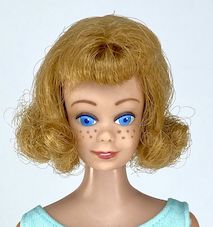
Same clothes, same body, but you knew she wasn’t really in Barbie’s league because, you know, freckles. Ugh!
Also before Annette there was Barbie’s little sister.
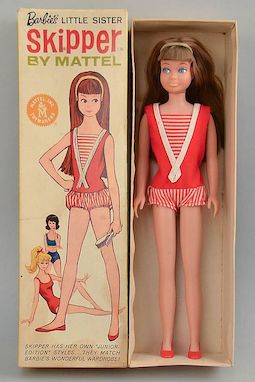
Oh, and look.

More tiny dresses for my poor mother to blind herself making by hand when I was asleep in bed. At least Midge didn’t need her own wardrobe.
I never had a Ken doll. Frankly, the felt “hair” creeped me out.

So I opted instead for an Allan doll, because moulded and painted red hair was better than yellow felt.
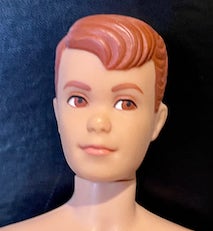
What did I learn from Allan (and the Ken dolls belonging to friends)? For a girl growing up with a single mother, nothing useful. The mystery of what was going on between men’s legs remained unsolved.
And then there was all the extra stuff you were supposed to have – Barbie’s car, Barbie’s dream home (pink, of course) and the rest.
I didn’t acquire any of this, but we did have a free standing cupboard that I converted into my own dream home – divided into four rooms, each “wallpapered” with wrapping paper, beds and couches made out of Barbie boxes and covered with different fabrics. If nothing else, it kept all the Barbie stuff in one place for which I am sure my mother was grateful.
By the time I was 14, I’d long since lost all interest in playing with Barbie and all hope of ever looking like her. When I was 17 I cleared all the dolls and clothes out of the cupboard, put them in a bag and gave them to Tori, the seven-year-old daughter of the art teacher for whom I used to babysit. On reflection, that was a pretty anti-feminist thing to do. Why should another young girl have the impossibility of Barbie inflicted upon her? It seemed like a good idea at the time. Tori was certainly excited. Not sure her mother felt the same way.
Decades later I would include this exchange in my play, Waiting for Nick.
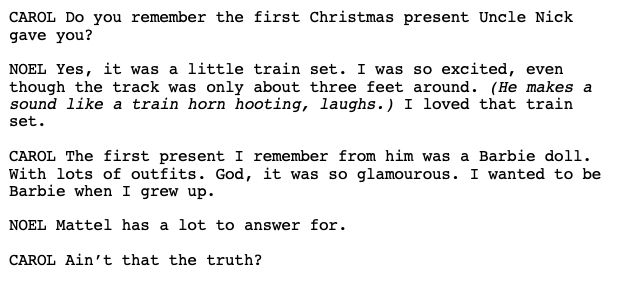
Okay, yes, since those early days Mattel has made some modifications.

The boobs don’t seem to be as big, the dolls are more diverse. Apparently they can now win an Olympic gold medal for gymnastics and – oh my goodness, what’s this? – even wear a Mumsie twinset.
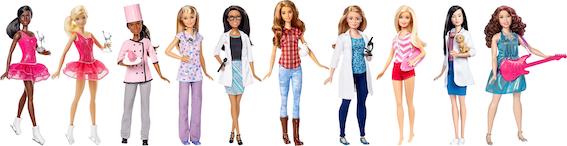
Nurses, doctors, scientists and – oh, is that a chicken under her arm? – farmers.
But her fucking dream house is still pink.
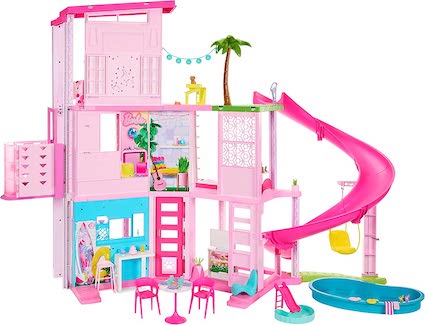
So, the film… Yes, when I heard about it there was teeth gnashing as well as eye-rolling. And disgust.
How could it fail to be anything other than a pink horror show?
And then a sensible woman I know (an Anglican minister no less) posted something on Facebook about Barbie – an opinion piece she’d written after seeing the film. My curiosity was piqued. (Adela went to see Barbie? What?) I read what she wrote (and encourage you to do the same) and thought, ‘Huh, is it possible this film is actually about something?’ According to Adela: “Ultimately, the movie is about everyone’s liberation, and how that requires all of us to make room for others.” Again: huh.
So, last night, after Barbie had turned up on one of my streaming services, I decided to watch it.
I can’t imagine any circumstances under which I would have started watching this film had I not read Adela’s piece, but if such circumstances had somehow existed, I would not have lasted past the opening in Barbie Land.
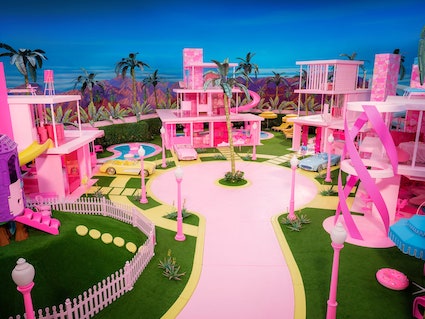
I mean, look at it. A pink horror story indeed. But then there was the “Real World” and a rude awakening for “stereotypical” (as opposed to “career”) Barbie. This real world is a place no Barbie should ever visit – or Ken.
Surprise! Yes, I liked the film. If I had daughters (or, more likely at this point, granddaughters), I would definitely take them to see it. I still wouldn’t buy them a Barbie doll (career or otherwise) or anything else that involved pink. I’d buy them a train set. Or a telescope. Or a microscope. But I would take them to see this film, because the real world does suck and they’d need to know this.
__________________________
PS: I cannot tell you how much I loved the fact that Allan was the only male immune to the patriarchy bullshit. I knew there was something wrong with that yellow felt.
PPS: I had no idea until I saw the film last night that at some point Mattel decided to marry Midge off to (and have her heavily pregnant by) Allan. A move that was the kiss of death for both of them. Do check out this article I found this morning to find out more about the short shelf life of Allan and pregnant Midge (and see the creepiest doll photo you’ll ever come across), along with the stories of other mindboggling Mattel marketing fuck ups. Sugar Daddy Ken? Holy moly.


 Anne M. Holmes